Leaderboard


Popular Content
Showing content with the highest reputation since 06/13/2025 in all areas
-
I tested resonance on what I believe is the most well known two stroke pipe, Gordon P Blair’s Grand Prix 125cc pipe. This 125cc road race pipe is in his book Design and Simulation of Two-Stroke Engines on page 444. All input data for this test matches Gordon Blair’s specifications. Rpm 11750 Exhaust duration 198 Exhaust gas temperature 600 degrees Celsius Tuned length 832 mm, total effective length calculated out to be 1181.5 mm After testing this pipe, it had very good resonance at 11750 rpm and 9315 rpm. The image is at peak power 11750 rpm.2 points
-
I wound up buying a motor city spark orange box. It's running great. They answered my questions quickly, and I like the simplicity of the wiring. I decided to go that direction.2 points
-
Although I haven't run those exact setups I think I can contribute some solid info backed with my own real world experience. I'm one of the oldies here with well into the thousands of 1/4 mile passes on a 4mil 421cub, hundreds on a 465 10mil cub and I have a son that ran an almost identical setup with a 392 cub. As you'd expect there's a performance increase with each step. I'm currently in the process of building a 611DM. It uses the same 64mm crank as my 10mil but with a 78 bore but where the big gains come from with the DM over cubs is it's ability to breath much better because of the MUCH larger intake and reeds. Good luck with whatever you decide2 points
-
This Banshee HQ thread is for HQ members that want to understand how two stroke pipes are designed using math. Anybody following this thread will learn how to design pipes and have the know how to compete with the top pipe builders, at the track and on the dyno. We will discuss what software to use, types of formulas to use and tricks we do to get an advantage. Tell your friends that Banshee HQ forum is the only place to get this information. Will post some technical stuff soon.1 point
-
Awesome. id love to see what equipment (jigs etc) needed to make a pipe. Curious of templates and matching each side. thanks for starting this thread1 point
-
Probably one of the most important aspects of pipe tuning, you’ve read my posts about tuning with effective lengths formulas. An example pipe will make it easier to understand. It takes .265 milliseconds for pressure waves to travel through a header section 47mm (avg) diameter by 200mm long. It also takes .265 milliseconds for pressure waves to travel through a belly section of 110mm diameter by 150mm long. The example pipe shows the header section pressure wave travels 50mm farther than it does in the belly section in the same amount of time. Using effective length formulas makes it very easy to time pressure changes in the pipe for resonance tuning. The end of each section will start a return wave to and from the exhaust port. Header and diffuser sections are tuned and timed to be in resonance with the last diffuser, belly and baffle.1 point
-
I wouldn't cut the flywheel for that build, it should rev quick. If all I had was a lightened flywheel I would run it and see how it works.1 point
-
I test all pipe designs with Mota two stroke simulation software. Mota shows the 4 diffuser, 3 diffuser and 2 diffuser pipe designs will make over 70 horsepower at the crankshaft per cylinder. The test engine was a 465 Cheetah Cub on gasoline. The dyno results on all three made just over 113 horsepower and 60 foot pounds of torque. These pipes were designed for the heavy rider (doughboy class), the tuned length was much longer than the average drag pipe. Designing a pipe around the chassis weight / riders weight helps the heavy rider like myself to launch without bogging.1 point
-
Sent from my iPhone using Tapatalk1 point
-
Sent from my iPhone using Tapatalk1 point
-
The three most important formulas for resonance tuning are heated speed of sound, tuned effective length and horn coefficient. (Heated speed of sound) this formula converts exhaust gas temperature to pressure wave velocity. (Tuned effective length) this formula converts true tuned length of each section to effective tuned length of each section. An example pipe with a total tuned length of 1000 mm may have a total effective length of 1400 mm. The effective length of each section gets longer as the diameter gets bigger. A tuned effective length of 1400 mm on this example pipe would be used to time and tune for resonance. (Horn coefficient) the kh factor controls diffuser angles for smooth and controlled expansion.1 point
-
These three images are the same two diffuser pipe, it has resonance at 10150 rpm and 7772 rpm. At 6048 rpm the belly section return wave has no support from a diffuser section. Sections in the pipe not including the main wave from the baffle have two return waves tuned to be in resonance with the header or a diffuser section with 4 return waves. A three diffuser pipe has a diffuser section supporting the belly section!1 point
-
Sent from my iPhone using Tapatalk1 point
-
Sent from my iPhone using Tapatalk1 point
-
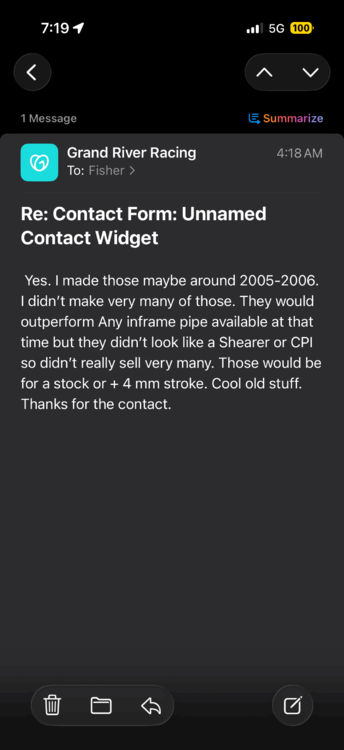
in case anyone was still wondering, I got a positive identification on the mystery pipes this morning.
 1 point
 -
Ordered the new cylinders today & need to get some longer rods. Time to redo the infamous DMX. Here's to having a bigger motor! 🍺 2BKING 🙃1 point
-
Post pictures using the Tapatalk app then search BansheeHQ. Once I get to see the pictures I might be able to steer you in the right direction on repairing the problem.1 point
-
Pilot sounds fat, On redline 421 serval with same mods on pump 93 im at 42-45P and 152-158M depending on temps.1 point
-
Q? Why gas and not meth? Good to read you're still out messing with the DMX. What lockup system are you using? All of my experience is on sand obviously, but its AMAZING how tunable a traditional lockup is. Are you guys white striping the tire then taking vids and slowing it down to see how many rotations its making to the 60 stripe?1 point
-
Most folks switch to a long rod on just about any build once the stock crank shits the bed. The theory is that the rod angle has less wear on the piston and the skirts stay together longer. Just takes a different piston combo. Just about every crank manufacturer has a 110 and 115 option, most opt for 115.1 point
-
However, in today's age stock stroke 115 rod motors aren't common. Cost same to build a 4mm1 point
-
Driveline is making transmissions now. If you just want a Pro Mod, send it to Tyson. As far as the carbs, the 33’s might net a few hp up top. The 28’s will keep it very snappy and get right in the pipe. If you’ve already got the 33’s, it wouldn’t hurt to toss them on and take them for a ride to see what you think. But to jump to the big 38–39’s might make a handful more hp on the dyno, but would make it way less fun to ride.1 point
-
I got snipers chromed….here in so cal. Sent from my iPhone using Tapatalk1 point
-
What type of fuel are you using? A few months ago I was working on a Banshee for a friend of one of guys that to that rides in our group. It was experiencing the same symptoms that you are describing. I went completely over the banshee from compression test to leak down test and exchanged carbs, reeds and even all the electrical part from an excellent running banshee and the symptoms were still there. It drove me absolutely nuts. I even drained the fuel to see if it was contaminated. It looked fine and so I put it back in and it still had the same symptoms. I then again drained all the fuel out and I even flushed the tank out and put some of my own fresh 32:1 pre-mix and the symptoms went away. So I talked with the owner and asked him what type of fuel he was using and he told me that he was running VP T2 fuel and mixing his fuel @ 32:1. He didn’t know that VP T2 comes already mixed @ 40:1 from VP racing. So he was adding 32:1 to fuel that was already pre-mixed @ 40:1. So the problem could be with your fuel that you are using. A lot of states start right around August to switch to winter blend fuel and fuel at your local gas stations are loaded ethanol which is not good for anything other than your car depending on the percentage of ethanol. I have everything I own from my 1987 Buick GNX all the way down to my weed whacker is on an ethanol free diet. In my area I can get ethanol free 95 octane Sunoco Optima at the pump locally.1 point
-
I have a mod quad from fast, I don't have a lock out clutch, I just wanted it for easy clutch access and looks. I have xrf nerfs bars, I didn't have to bend the brake pedal. Just had to adjust it down a little bit. Only thing I didn't like, is the button head screws are soft. Heads started stripping before I hit the recommend torque value on them.1 point
-
Just keep in mind, mrbill doesnt have ... big feet,so1 point
-
Any one of those covers are great!!! Nothing wrong with them. Yes bend the lever but it is not drastic, no foot placement is fine. Sent from my iPhone using Tapatalk1 point
-
The way they look in the picture they look like they are installed correctly. With the design of the upper A-arms, if you can stand over each side and look down at the upper heim joint it should either match up or sit slightly back ( about 1/4”) to the lower ball joint. ** I also think that you have to install the stock dust caps from the upper and lower OEM A-arms onto these A-arms.1 point
-
Torque , it can be done with all. But my 465 @ over 450lb runs 3.6's It's not how close to 475 you can get... that matters1 point
-
No… The stock heat shields will not work with the Toomey T5’s. You will just have to learn how to ride with your legs spaced away from the pipes or you’ll learn a hard lesson really fast. Most likely ever Banshee owner has burnt themselves on their calves or legs at least once or twice in their lifetime while riding.1 point
-
Do a comparison check on it. Their is no reason to be running 110 octane fuel if it's not needed. I didn't see anything in the description to justify 110 octane fuel.1 point
-
Hell ya, thanks dude. Wanted to make sure before I slap it all together. Sent from my SM-S928U using Tapatalk1 point
-
Great info. i used to build mountain bikes (totally different I know) but once I went to ceramic bearings in my hubs I never went back. They lasted forever and showed no wear. Definite noise difference though1 point
-
With 2.68 straight cut primaries I used TZ's on both the clutch and stator side but with my sustained high rpm 1/4 mile runs light brown color always showed up on the inside races. In never saw any galling but the color obviously indicates skidding and heat buildup. With barrel rollers they have more drag also. I'd pretty much decided on going with Max loads even though they're prone to cracking races if subjected to detonation which I sometimes get with my alcohol motors and they don't have near the TZ's load carrying capacity but for better or worse I ended up going ceramics this time. We'll see if that was a wise decision or not! Personally if I was doing a gas trail type motor I would go either Koyo or Max loads.1 point
-
Good call. I spoke with them today and I'm going to go with them. They come ready for my 485 Cylinders too.1 point
-
Looks to be 9500 with boost bottle and fatts. ">1 point
-
Get a Clymers manual or download pdf and fix it yourself. These things are only slightly harder than a tri-cycle to fix A stealership is going to give it to you in the ass w/no lube.1 point