




deckheight
-
Posts
272 -
Joined
-
Last visited
Content Type
Profiles
Forums
Events
Gallery
Store
Everything posted by deckheight
-
I got my A. Graham Bell copy from you folks like twenty years ago (probably an earlier revision than current... LOL!). Came free with a tooling order. Still get most of my carbide and cartridges from you, tried the cheaper stuff and it is not worth it! Would probably get new motors and handpeices from you too, but don't need any. Still using the original stuff, it don't look so shiney anymore, but it seems to last forever when properly maintained. Better to only cry once sometimes... Been a while on that website hasn't it... Sheesh!
-
Nikasil Coating for Re-bored Cylinders
deckheight replied to prossett's topic in Banshee Repairs and Mods
Actually they are cast iron alloy sleeves, totally agree on the rest of it. -
Same here on the T-5's, very good "all around" pipe. And a set of Boyesen "power reeds" will do you. Carbon fiber reeds have their application and your not it...
-
Not sure I understand the question... However, in this case, +/- equals one or two thousands. An OEM head squish band width = apx. 10mm not including the blending radius into the chamber, combine this with .048" - .052" squish thickness and a compression ratio suitable for 93 octane fuel and it will yeild a maximum squish velocity in the mid 20's (+/- LOL!). Right where it should be for lower octane fuels on a very mild build Banshee motor IMHO. I am also saying... Use the old head gasket rather than compressing the new one when the head is torqued down to establish an existing squish thickness so it can be determined what needs to be done with the head as far as machine work. This is all assuming the head casting number is a 2GUY-2 and not one of the 2GUY-1's that came on the very early motors. If it is a 2GUY -1 then don't even bother since they start out with apx. 2cc larger chambers to begin with! Facing .030" off a 2GUY-1 will just put you very near what a 2Guy-2 is (chamber volume wise anyway) to start with...
-
Install the head using the old (cleaned up) head gasket and check the squish thickness. Your shooting for .050" +/- final clearance for 93 octane pump gas. So if you have .080" or more squish thickness before cutting the head and you intend to face .030"... Perfect! Otherwise the squish band will need to be cut also.
-
Sorry... It refers to "flat plate" volume. Some builders/tuners might call it dome volume or head only volume... Even though your blowing a lower number on a static compression gauge after raising the exhaust port, your full stroke compression ratio has not changed at all and your corrected ratio has probably changed very little. In other words, what your combustion chamber pressures are at a couple hundred rpm while performing a static compression reading have very little to do with what the same chamber pressures are once the engine is actually running and the tuned exhaust is functioning effectively. To put it yet another way, although it is better than nothing, a compression gauge reading is an extremely piss poor way of establishing fuel octane requirements! IMHO anyway... At any rate, kinda highjacking this thread... Shoot me a private if you have questions...
-
LOL! Drop a teaspoon of oil or even pre-mix down the spark plug hole and check it again w/your brothers gauge...
-
Mopar, did you get a buret? Check your trapped or F/P volumes at .030" yet?
-
I am not aware of any "comprehensive" books or videos available individually, however the instructional pages within the program (as well as included paperwork) you get when you purchase the TSR Port 2000 program will answer any questions you should have. Unfortunately, it will also lighten your wallet several hundred dollars... Short of that, probably the best individual book I have read would be A. Graham Bell's 2-Stroke Tuning. Is is IMHO, not very comprehensive and pretty well dated (I think it was first published back in the 70's or something). It does contain a lot of good 2-stroke info though and can probably be had for less than $30. There are other books I have seen mentioned on this site that I am not familiar with, try some of them maybe??? If you are an SAE member and find it "relaxing" calculating the geometry and force requirements of various body parts performing daily functions... Purchase Dr. Gordon Blairs original 2-stroke papers submitted to the Society Of Automotive Engineers. It's a real "put you to sleep" read. Also several hundred bucks...
-
You have to have a right angle handpeice to do banshee transfer ports properly, especially if transfer roof and entry angle control means anything to you. And that's all there is to it! Plenty of places sell tooling for porting... Jeweler supply/mould and die supply, etc. sell Fordom or Foredom style motors and flexshafts... If nothing else, do yourself a favor and get your initial carbide burrs from CC Specialty. They know what you need and sell tooling specific to what your wanting to do. There is a carbide quality difference... It is usually less painfull to only cry once! IMHO anyway...
-
What's already been said... Cylinder porting, efficent exhaust like CPI or T-5, 33mm Kehins, at least 100 octane top end and decent clutch. No need for a locker, etc. Swing arm depends on the rider... personally I prefer wheelying around everywhere I go... Plus the stock front shocks suck anyway LOL!
-
Your main problem (probably only problem) is the 116 octane fuel... 104 sounds about right w/17cc dome and stock deckheight. What your doing with the 116 and your compression is very similar to retarding the ignition timing. Maximum combustion chamber pressures have to happen at the right degree of crankshaft rotation. Too early and the piston is working against the expanding fuel charge, too late and the piston is already traveling away from it. Since the flame front with higher octane fuels travels at a slower speeds, you are not getting a complete burn before the exhaust port opens. Just spitting part of the fresh fuel charge out the exhaust port along with the rest of the exhaust gasses... I personally would have listened to Kevin from the start, sounds like he knows what he's talking about...
-
Since the trigger plate is already indexed, just set it at whatever ignition advance you want. If you want to actually confirm your ignition timing then you will need to index your flywheel, determine TDC with a dial indicator/spark plug fixture, install some type of pointer at your newly indexed flywheel and check it w/a timing light. Normally the way it works is... ASSUMING THE COMPRESSION RATIO IS CORRECT FOR WHATEVER OCTANE FUEL YOU ARE USING... Ignition timing needs to be advanced for higher octane fuels. Since higher octane fuels propogate a flame front at a slower speed, the higher the octane number the greater the ignition advance needed to realize maximum combustion chamber pressure at the correct degree of crankshaft rotation. I believe what A. Gram Bell was saying was in the context of increasing the C/R without increasing the fuel octane. If you are not sure what your squish clearance actually is you need to assemble the motor and check it. It doesn't matter head gasket or no head gasket, the domes have been machined for the stroker crank and o-ring head... Right... The clearance is the clearance! Get the port work done now since your gonna have to do it anyway... Jeeez, you just increased your stroke 4mm! It will run with out the porting, but not very efficiently, should be extremely responsive at lower rpm's however... LOL!
-
It is the angle at which the squish band is cut, in this case 12 deg. from a horizontal axis. Normally 1.5 - 2.5 deg. greater than the crown of whatever piston is being installed allows the squish band to help direct end gasses toward the center of the combustion chamber.
-
This is where I got most of my stuff http://www.ccspecialtytool.com/ Should give you a pretty good idea of what is available... Basically you will need a motor, at least one 90 ded. handpiece and at least one straight handpiece, several burrs, several grits of sandpaper rolls and mandrel and a slotted mandrel with green and red scotchbrite pads. The stuff is not cheap!!! Exhaust port polishing is done with sandpaper rolls and finished off with the scotchbrite in the slotted mandrel, unless of course you want a "mirror finish" (which BTW does absolutely nothing) then you will need polishing componds etc. I have not forgot about the other thing... Still slammed...
-
The machinist needs both pistons to bore the cylinders and fit them properly. Wiseco's, since they are "machined finished", are usually within .0005" between the pair and quite often dead nuts between the pair, in which case it wouldn't matter which slug went in which hole... But every once in a while, especially with cast pistons and sometimes even with Wiseco's, there will be .001" or more, then things get a little more critical. If the engine is stock compression, follow the piston manufacturers recomendations for clearance. If higher compression, consider opening it up a little accordingly due to greater piston expansion from higher combustion chamber temps. Ask your machinist to visually inspect both pistons, especially around the ring lands and check both for taper. No comment on the rotten pricks who won't bore cylinders unless the parts are purchased from them...
-
The early signs of piston slap
deckheight replied to LIM_Whiteboy4life's topic in Banshee Repairs and Mods
No accurate way to do it other than disassembly and inspection with mics and bore gauges that I know of. Sorry -
mopar, I have cc'd several of both castings and both have consistently been within 0.2cc from head to head. 2GUY-1 castings=24.20cc chamber volume. 2GUY-2 castings=22.40cc. Don't forget to add another .84cc to both for an OEM head gasket, if your using one, and/or trying to make some type comparison to one of the after market O-ring type heads. IMHO, there are several things effecting what a proper squish velocity would be for a particular engine... Squish thickness just being one of them... I would really like more specific data before commenting. E-mail me private if you want. I can say that I have never needed to run less than .045" on any 2-stroke engine to get the MSV I needed for that particular application and that being only on extremely high compression motors. Normally I see .048" to .053" for 92 thru 110 octane set-ups with normal squish band widths (10mm +/-). At any rate, that's what works for me... However, MSV opinions vary... And unfortunately, it is quite often debatable... I agree with brugal... For what one of the Noss or Chariot style head assemblies cost, it is not making much sense for someone to pay to have an OEM casting worked over, unless of course a person could get it done pretty cheap or is going for a sleeper look or something... Plus the OEM castings are pretty thin around the coolant in and out areas. It is not unusual to have to tig weld "plugs" in those two areas if more than .070" or .080" needs to be faced.
-
I am getting .904" with a decent digital caliper... I would think that .004" is within OEM tolerances.
-
.020" will reduce the OEM chamber volume apx. 1.66cc. From what I have seen the heads w/2GUY-1 casting numbers are from early Banshee motors and have apx. 1.8cc larger chamber volumes than later 2GUY-2 castings to start with. Both castings are well within being 92 octane safe (assuming OEM deck height) and will result in a squish thickness of apx .060" (again assuming OEM deck height) w/.020" faced off them. I'll let you do the rest of the math... If you need more info let me know. Good luck
-
Not trying to be a smart arse, but just a heads up... Ask them/whoever if they re-balance after removing material. Your left side main bearing will very much appreciate it! Doesn't have to be anything fancy... Just a static balance will do. The OEM's don't spend the x-tra $$$ for balancing the new ones because they're nice guys...
-
Yeah, I ain't too swift with internet/computer type things... I couldn't even figure out the Imageshack stuff... and resizing the pics... bla, bla, bla. Total PITA actually! I have not done a lot of Banshee motors, mostly PWC engines. But, Banshees seem to react as expected to the usual 2-stroke go fast stuff. Oh yeah, as far as the back yard Hack thing... I certaintly don't claim to be an "expert" machinist or tuner, but in my experience, the right equipement in the wrong hands does a lot of damage, a lot of fast! IMHO anyway. Since I opened my big pie hole and sort of set myself up here... Just didn't want everybody to think I was blowing smoke... Errr, too much smoke anyway I'll go back to lurking now... Good luck, Chris
-
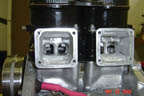
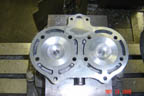
A couple more... I couldn't attach more than two pics per post due to file size limitations. This particular engine went in a mild mannered 100 octane dune runner, ported for T-5's, lightened flywheel, tunnel ported cases and a few other minor things like 33mm PWK's :cool: . Just a good running, reliable recreation set-up, 70 horse power +/- type engine. No big deal! The bike is a sleeper and looks like all the rest of the "bolt on" racers at first glance... LOL! First one is the same head, finished and tig welded before before coming off the mill. Second is just the reed area on the intake side, doesn't show any of the transfer or exhaust port massaging...
-
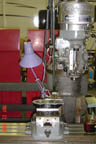
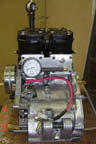
Dave, sorry for the delay on the pics... I am pretty slammed right now, but more so it was because I am a "computer idiot"! The first one is checking the volume of an OEM head I cut for 100 octane fuel. Second one is bringing the left piston to TDC to establish a combustion chamber trapped volume so I could calculate a compression ratio. It shows the block off plate I am currently using to pressurize the cases.
-
Allright, thanks. I'll give it a try. I am what you might call a "computer idiot"