SlowerThanYou
-
Posts
2,159 -
Joined
-
Last visited
-
Days Won
10
Content Type
Profiles
Forums
Events
Gallery
Store
Everything posted by SlowerThanYou
-
Our quad & trailer is headed for the GATORNATIONALS in Gilbert, LA. Apr. 24-28. Wish I was going, but we have 3 days of drag racing in the same period of time. Our Puerto Rico Team will have 3 quads competing. Angel will be riding ours (443 Cub on race gas) in limited 0-525, bracket & possibly index. Angel's quad (535) will be in limited 0-650. Noel will run 0-825 limited & unlimited. Last time out, Noel went 3.52. The old record stands at 3.48 & new ones haven't been established for PSDA.
-
We use a launch limiter that controlls the rpm. If that's what you are getting at. It's a little more involved than my simple explanation.
-
Acetone will change the burn rate.
-
This sums it up better than I could explain! Where it says car, insert ATV and we require a little higher rpm than used in the example. Other than that, that phrase pretty much hits the nail on the head. There's much more that goes along with it to make it work effectively & more efficient. "What is the optimum clutch setup? At the starting line, the optimum clutch setup will allow you to apply as much power as possible to the rear wheels without losing traction. This is accomplished by controlling the amount of clutch slippage with adjustments to the static and centrifugal pressures. For example: The clutch could be set with moderate static pressure and the correct amount of centrifugal weight to allow the clutch to slip as the car leaves the starting line at relatively low RPM. As the engine RPM increases in first gear, the centrifugal assist increases, gradually locking the clutch up and applying full power to the rear wheels. If the clutch slips too much off the line, additional static pressure could be added, or the launch RPM could be raised to allow the centrifugal weights to begin locking the clutch up sooner. If the track conditions were poor, the static pressure could be reduced or the launch RPM reduced in order to allow more slippage and maintain traction. "
-
1st, I would like to thank you for time on the phone today. I also spent about 2 hrs. talking with Titan Racing today. The clutch tuning was the main topic also, among others. I was hoping to be a little farther along on this topic, by now. You bring up some very good points and maybe I ought to re-baseline or clarify some of the information. Stay tuned & be patient. Bryan
-
Finishing up. Our current combo with the billet crank Was torn down, inspected, new crank bearings & new seals put in Mar. 2010. All the hard parts crank, piston, rings, nickasil, domes, & tranny have around: 300 1/4 mile runs, 90 hill shooting runs & 90 300' sand runs. I'm not to worried about the motor & plan to run it 300' for this year & possibly next year. Now, with you only having around 160 runs. If it was my motor, but it's not. I wouldn't touch it. You have to make that decision for yourself. You know your quad better than I. Our current conbo has been ran on minimum leaded 110 octane race fuel @ 40:1 with Klotz Supertechniplate. If you have any more questions ask away.
-
Listen to the guys that actually run at least 1/8 mile. There's only a few that run 1/4 successfully fast & Tedder has replied already. Nothing against the 300', but the stress on the motor is less severe & I've done both. Now to answer your question. We need to know what fuel, oil & oil ratio you are using. Plus, your shift rpm & what rpm it goes thru the traps at & some basic motor information. We baseline our motor when new & broken in with a compression check. We then use that baseline when checking compression throught the season. We use that as an indicator to ring & piston problems. As for the crank, we look at replacing or rebuilding around 400 runs. Our 1st crank (cast 7mm) got 450 runs before the lower rod bearing cut loose. That crank was primarily run on alky with around 75 passes on race gas. Our current crank (billet 7mm) has around 300 1/4 mile passes. OOPS got to run, I'll finish later.
-
You need to leave in 1st gear on asphalt and we do the same on sand also. That's going to be pretty hard to do with a 2-5, but not impossible. Your gearing will have to change also depending on many different factors. Need to know your primary gear ratio & what tires you are going to run for starters. You really need to give me a run down of your complete set-up!
-
Thanks Arlo for the compliments on our quad. You put down some outstanding runs yourself & you are no little jockey either.
-
Here's the hardware from our work.
-
Arlo & I was having a good time drinking, if we would of had another drink. I'm sure we could have run a 1.10 sixty in our mind. LOL! You can come next year & see our Slow Sleeper Banshee run. We are finally starting to run low 1.4 60's with the Rippers and hope to be back in the 1.3s next time out. We are testing so many different areas, while we race. This clutch has around 170 passes on it. It's still working decent, but we can pick-up an easy .1-.2 with a fresh clutch. I was going to replace it after this race, but I think I'll leave it in for more runs.
-
-
I've never used these & you should talk with Skat Trak to see if they fit your circumstances. http://recreationtires.com/tires.html?ct1=Skat-Trak&ct2=Terrain Trak
-
I got a few things to share about the clutch/primary springs that hasn't been covered yet. The primary springs control the initial slip at the drop of the clutch & out to around 15' off the line. It can be extended some with a multi-stage lock-up. The lock-up arm wieght starts with tire rotation/slip/wheel speed or engine rpm climb depending on the lock-up being used. I'll give two different examples: 1st, drop the clutch & the motor immediately bogs or tries to kill. If everything else is good with your engine tune-up. The I would remove a certain amount of base/static spring pressure. How much you remove is based on many things, but primarily your experience. We have a certain way we do this with shims. We can add or take away pressure with .005 - .062 shims & everything in between. 2nd, drop the clutch & the rpm/wheel speed climbs. You get off the line & about 5'-7' and the motor bogs. This is getting to the transition area where the lock-up arms are coming in. I would 1st remove a little weight from the arms, but depending on other factors you could remove base/static pressure. There are a just a few examples & we are starting to get away from the primary springs. The next area I'll cover, will be the lock-up arms. I didn't cover any of the primary spring spring pressures (static pressure). I will say this, a standard lock-up will require less static pressure than a Multi-Stage hub/basket driven lock-up. Lets start with the arm weights. IMO, there's only one way to measure the arm weights. We use a small pocket scale bought from Harbor Frieght for around $14. We prefer to use grams for weighing the arm weights. We used to use a + or - of .1 gram for our standard, but we find ourselves trying to get it perfect as possible with the cheap scale. The Multi-Stage lock-ups have more adjustability than the standard lock-ups. With standard lock-ups, the arms start applying a lot quicker. Hence the reason to run less static spring pressure to kind of crutch its lack of adjustability. I think it was Springer that caught on to us using different weights on the arms. We could & sometimes do use different tower arm springs to change/delay the arm engagement. It's a lot easier to use all the same tower spring pressures & adjust the weights for arm engagement. Next time I'll provide some examples for tuning the arm weights.
-
Since 2008 we have been on gas, but we have about 300 1/4 mile Alky runs without a pump. We started with a pump for about 150 runs & we carried two.
-
A couple of us run 1/4 mile without a pump. I started with a pump & weaned myself off. You have to have everything right, but it's less hassle without one.
-
We are racing in Bakersfield, CA. this coming weekend. The track is supposed to be a little slow, but we will find out. It looks like it might be our last race until the fall. We were planning on the PS race in Mar, but it keeps getting changed. That weekend is our local points opener, two day race. From PS: Planet Sand Drags scheduled for March 28th-31st 2012 in Dome Valley have been canceled. We are working hard to move the race location, keeping it in Arizona and tentatively changing the scheduled dates to April 19th, 20th, 21st 2012. More information coming soon.
-
Thanks, the runs were a couple of our slower ones. As for the wheelie bar, I don't like the wheels we have on it. I'm going cut a one piece wheel hopefully. The bar is holding up well so far. I hope it doesn't damage it for asphalt.
-
Some one has a good eye & I wondered if anyone would pick up on it. With our multi-stage we can stall our lock-up arms by changing springs in the tower (under patented). There are 6 springs, 1 for each arm. We tune the arms with both the springs & weight. I have also been tuning on standard lock-ups also & have a pretty good data base of information. As for the clutch frictions we primarily use Yamaha fzr 1000 fibers. We have played with Barnett kevlar and want to try carbon fiber frictions some time soon. As for the steels, we use different types of materials, treatments & coatings. We have a pretty detailed maintenance & inspection program for the clutch frictions & plates. As for being hush hush this information has been out there starting around the 1960s. It's not always easy to find! A few of us have done a good job of compiling it, then testing it in our quads. The information isn't always staring you in the face, it has to be adapted to our/your platform. I will be updating some more information in the future. I'm going to keep the closely guarded sectrets to myself & a few friends.
-
You need to baseline your current set-up. What's your base pressure total weight @ the springs installed height? What's your arm weight in grams on each arm? Your 60' time will tell the story. You keep adding or taking away base pressure to improve the 60'. If it bogs or spins excessively you have too much. If it drives thru the clutch (mushy) you don't have enough pressure. Your arm weight is used to lock-up or stop the slip. This will usually show up in the higher gears 5 & 6. If it show up earlier, you are really off with the arm weights. There's really much more than what I've covered so far. I'm not reinventing the wheel here. The info is out there & I researched to find it. Then I used a little common sense to apply the information to our needs. I can probably cover everything I know about clutches, but I don't plan on giving away everything. Anyway, It still comes down to the tuner to make the right decisions to make it work with the rest of the combination
-
The 1st video we had the PJ opened up. This video shows how clean it is when it's closed. We have tried the power jets numerous times & they don't seem to work right with gas.
-
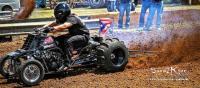
443cc Cub on race gas, stock frame and no light weight jockeys.
-
Not yet & we are not far off from what we ran 1st time out. We fixed the spinning in 3rd/4th gears & picked up mph. I know that doesn't win races. We need a gear change, some clutch base pressure adjustments and a few other small changes. We had some problems running with the cars, trucks, Top Fuel dragsters and whatever else was on the track. It made for some pretty wild rides. We also had some other problems, like part throttle & we have also been testing max runs on a clutch. We are at 100+ runs on asphalt, around 40 on sand & plan to get another event out of this clutch @ Bakersfield, CA. We know @ around 100 runs we lose a little performance. We are trying some different maintenance techniques to extend the life a little bit.
-
Here's a video of one of the runs.
-
I'm planning to cover all aspects of the clutch eventually. We snuck an extra unexpected sand race in & I'm pretty busy. Anyway, glad someone has a question. There have been plenty of them at the track. IMO the ideal set-up will only slip to around 30' out of the gate. Plus, you want a little slip on the gear changes. The slip on the gear changes, I haven't totally mastered yet. When we originally started this science project back in 2005. We were getting 4-5 runs out of a clutch. It took us a couple years to get 40-50 runs. The current clutch we have in now has over 100+ asphalt runs & 35-40 sand runs. I'm doing my last servicing of it to hopefully get another 20-30 runs out of it